Service Offerings

Explore tailored services designed to solve business challenges and support growth

Industries

Discover industry-focused expertise built to meet unique business needs

Partners

Meet our service partners who strengthen delivery and support client success

Meet our service partners who enhance our capabilities, strengthen service delivery, and help drive successful outcomes for our clients.

Discover how HamiltonJet is exploring secure, practical agentic AI to unlock new opportunities within Infor M3.

Fortude helps a US-based, global leader in metal working fluids drive digital maturity on Infor CloudSuite Chemicals

Discover how a global manufacturer optimized ERP operations, reduced inventory counting time from one week to one day, and built a roadmap for digital transformation.

Products

Explore our digital products built to streamline work and drive growth every day

Partners

Meet our product partners who enhance our solutions and expand client value

Resources

Access blogs, case studies, events, and insights that support smarter decisions.

Latest Resources

BLOG

Order capture agent as a control point: Using AI to improve upstream order quality

CASE STUDY

Fortude drives multi-site cloud migration for The Compleat Food Group across the UK

Our People

Discover a culture where you can grow and shape what’s next

Everyone can grow at Fortude

We believe in creating a global workplace where everyone can grow. This is amplified by our teams, who say the best thing about Fortude is our culture, one that is brought to life by a diverse team that spans across continents.

Latest

Fortude builds momentum for women in tech with all-female Ignite 2.0 tech internship

Aug 22, 2025

Pioneering innovation and inculcating learning in the age of AI

Aug 01, 2024

About Us

Learn who we are, what we do, and the values that drive our growth

News & Events

Stay updated with Fortude news, events, stories, and company highlights.

Contact Us

Get in touch with our team to ask questions or start a conversation

Your nearest office- Sri Lanka

Fortude (Pvt) Ltd
146 Kynsey Road, Colombo 7, Sri Lanka

Email – talk-to-us@fortude.co
Phone – +94 11 453 1531

What defines us goes beyond what we do

Every day, we bring together diverse perspectives, strong leadership and responsible thinking to build a business that creates lasting value for our clients, people and communities.

Fortude disrupts ERP delivery with agentic AI across the Infor CloudSuite lifecycle

Office locations

AI and Digital Advisory

Why the Fractional Chief AI Officer is the next evolution of digital leadership

7 min read

October 26, 2026

Share

 
  • A Fractional Chief AI Officer provides executive AI leadership without requiring a permanent C-suite appointment.
  • The role connects AI strategy, governance, data, operating-model decisions, adoption, and ROI.
  • It complements rather than automatically replaces the CIO, CTO, or other technology leaders.
  • The need becomes more urgent as enterprises move from AI assistants to AI agents that can participate in workflows.
  • The goal is not to deploy more AI. It is to turn the right AI investments into governed, measurable business value.

Last year we explored why a growing number of businesses were turning to a fractional CIO to provide strategic technology leadership without adding another permanent executive role. Since then, the leadership challenge has changed.

AI is no longer confined to experiments run by innovation teams. It is entering finance, operations, customer service, supply chains, ERP delivery, and everyday decision-making. As that happens, organizations need someone who understands more than just the technology. They need someone who is accountable for deciding where AI belongs, how it should be governed, and how investments translate into business outcomes.

That is where the need for a  Fractional Chief AI Officer is emerging in the digital leadership space.

Who is a Fractional Chief AI Officer?

A Fractional Chief AI Officer is an experienced executive who takes responsibility for an organization’s AI direction on a part-time or flexible basis. The role combines AI strategy, governance, prioritization, risk management, adoption, and value realization without the commitment of hiring a full-time CAIO.

That role matters today because enterprise AI adoption has reached an inflection point. According to an IBM study, 64% of surveyed CEOs say they are comfortable making major strategic decisions based on AI-generated input. The CEOs also stated that they expect operational decisions made by AI without human intervention to rise from the current 25% to 48% by 2030. 

This is increasingly an AI leadership problem rather than purely a technology problem.

Fractional Chief AI Officer vs. CIO, CTO, and full-time CAIO: Who owns what?

A Fractional Chief AI Officer should complement existing executives, not create another competing technology silo.

Role

Primary focus

Best suited for

CIO

Enterprise technology strategy, systems, security, operations

Broad ownership of the technology estate

CTO

Technology architecture, engineering, products, innovation

Organizations with significant technology/product development

Full-time CAIO

Permanent enterprise-wide AI ownership

Large organizations with mature, extensive AI portfolios

Fractional CIO

Flexible technology strategy, vendor and budget oversight, and digital transformation

Growing organizations needing senior technology leadership without a permanent CIO

Fractional Chief AI Officer

Flexible AI strategy, governance and value realization

Organizations needing senior AI leadership without a permanent CAIO

The right structure depends on maturity. A company with dozens of production AI systems may justify a permanent CAIO. A mid-market enterprise still establishing priorities, governance, and its first scalable AI programs may benefit more from fractional AI leadership.

Why is the Fractional CIO evolving into a Fractional Chief AI Officer?

The Fractional Chief AI Officer does not make the CIO obsolete. Instead, the role reflects how the executive technology agenda is becoming more specialized. Our earlier Fractional CIO article explored how fractional executives can provide additional leadership bandwidth across cloud platforms, cybersecurity, enterprise applications, architecture, vendors, budgets, data, and digital transformation.

AI adds another layer of decisions. A Fractional Chief AI Officer turns fragmented AI activity into an enterprise program with priorities, guardrails, accountable owners, and measurable outcomes.

Typical responsibilities include:

  • Translating business goals into an AI strategy and roadmap
  • Identifying and prioritizing high-value use cases
  • Establishing governance, decision rights, and risk controls
  • Defining responsible AI policies
  • Evaluating platforms, models, vendors, and build-versus-buy decisions
  • Coordinating business, data, security, IT, and delivery teams
  • Establishing adoption and change-management programs
  • Communicating progress and risks to executives and boards

When does your business actually need a Fractional Chief AI Officer?

Common warning signs include:

  • Teams are running disconnected AI pilots with no enterprise roadmap.
  • Executives are receiving competing AI investment requests.
  • AI spending is increasing without clear ROI measures.
  • Data quality is limiting promising use cases.
  • Employees are adopting AI tools faster than governance can keep up.
  • The organization is struggling to move pilots into production.
  • AI agents are beginning to interact with business processes and enterprise systems.

How does agentic AI change the Chief AI Officer's job?

Agentic AI raises the stakes for AI leadership because AI is moving from generating outputs to participating in workflows and taking actions toward defined goals.

IBM’s analysis indicates that organizations with an AI-first approach to C-suite design have scaled 10% more AI initiatives enterprise-wide than their peers. As reliance on AI increases, so must the importance of governance.

As agents take on more autonomy, the Fractional Chief AI Officer sets the limits: what an agent can decide, what it can access, when a person must approve, how its actions are audited, and who owns the outcome. Those limits are reviewed continuously, with agents restricted, retrained, or retired as risks change. 

PwC’s 2026 guidance on AI-agent governance similarly emphasizes defined roles, task-specific permissions, auditable records, and increasing human oversight as autonomy and consequences increase.

What should the first 90 days with a Fractional Chief AI Officer look like?

A Fractional Chief AI Officer should create clarity before encouraging the business to accelerate investment.

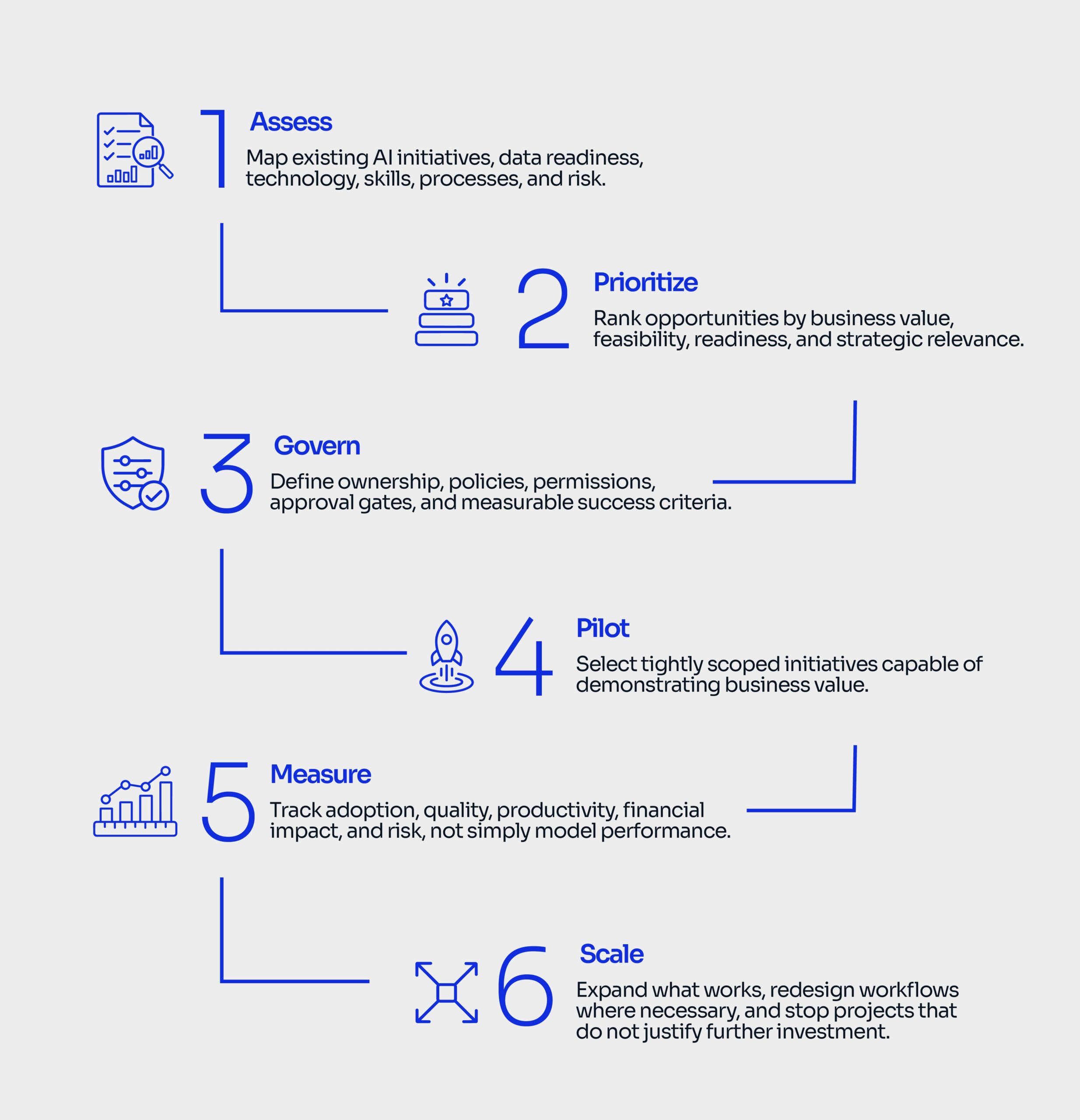
A practical first 90-day agenda follows six steps:

first 90 days with a Fractional Chief AI Officer

As AI moves into core business processes, the real question is who is accountable for doing it well. A Fractional Chief AI Officer provides that senior ownership without a permanent C-suite hire, working alongside the CIO and CTO to set priorities, put governance in place and tie AI investment to measurable outcomes. If your AI activity is starting to outgrow the structure managing it, Fortude’s AI and Digital Advisory services can help you shape a practical path forward.

Ready to move from AI experimentation to accountable execution? Talk to Fortude about building a practical AI roadmap for your business.

FAQs

Who should a Fractional Chief AI Officer report to?

A Fractional Chief AI Officer needs direct access to senior decision-makers because AI priorities often cut across technology, operations, finance, legal, security, HR, and business functions. Depending on the organization, the role may report to the CEO, CIO, COO, or another executive sponsor.

Look beyond technical AI expertise. A strong candidate should be able to connect AI initiatives to business priorities, establish practical governance, challenge weak use cases, work across executive and delivery teams, and demonstrate experience moving AI programs beyond experimentation into operational use.

Yes, a Fractional Chief AI Officer can help define roles, identify skills gaps, establish an AI operating model, mentor internal leaders, and determine which capabilities should be built in-house versus supported by external partners. The aim should be to strengthen the organization’s internal AI capability over time.

A full-time CAIO may become appropriate when AI has evolved into a permanent enterprise capability with a significant portfolio of initiatives, dedicated teams, substantial investment, and ongoing governance requirements. The transition should be driven by the scale and complexity of the role rather than company size alone.

CONTENTS

Receive the latest
Fortude Newsletter
updates.

Share

Related Blogs