77% of organizations still manually enter invoices into their accounting systems. Only 19% describe their AP function as mostly or fully automated. This statistic indicates that most organizations are still handling invoices by hand somewhere in the process, whether that is data entry, matching, or approvals even after investing in automation tools.
These numbers may come as a shock because the industry conversation has already moved on. Most finance teams are no longer debating basic automation; they are talking about agentic AI. However, it is worth stepping back before jumping ahead. In this blog, we will explore the challenges finance teams still face, the ideal roadmap for AP automation, the dangers of rushing toward agentic AI, and a real-world example of what this looks like in practice.
The challenges finance teams are working through
Finance teams face a handful of recurring problems, and they explain why tools alone haven’t closed the gap.
- Approvals are the real bottleneck: Invoice capture may be automated, but approvals still happen over email. As a result, the manual step does not disappear; it just moves further down the line. An invoice can be extracted and matched in seconds, only to sit in an inbox for days waiting on a sign-off.
- Exceptions still require a human touch: Rule-based systems handle invoices that follow an expected pattern. The moment one doesn’t, whether due to a pricing mismatch, a missing purchase order, or a duplicate, the entire workflow stops and waits for manual review.
- Fraud is getting harder to catch by hand: Fake invoice scams are becoming more common. Vendor impersonation and business email compromise are increasingly convincing because fraudsters are now using AI tools of their own.
- Lean teams compound every efficiency issue: Institutional knowledge often sits with a small number of experienced staff members. They are the ones who know which supplier always runs late, or which minor exception is safe to wave through. When that knowledge is not captured anywhere else, every problem in the early stages of the process takes longer to fix.
Our roadmap for AP automation success
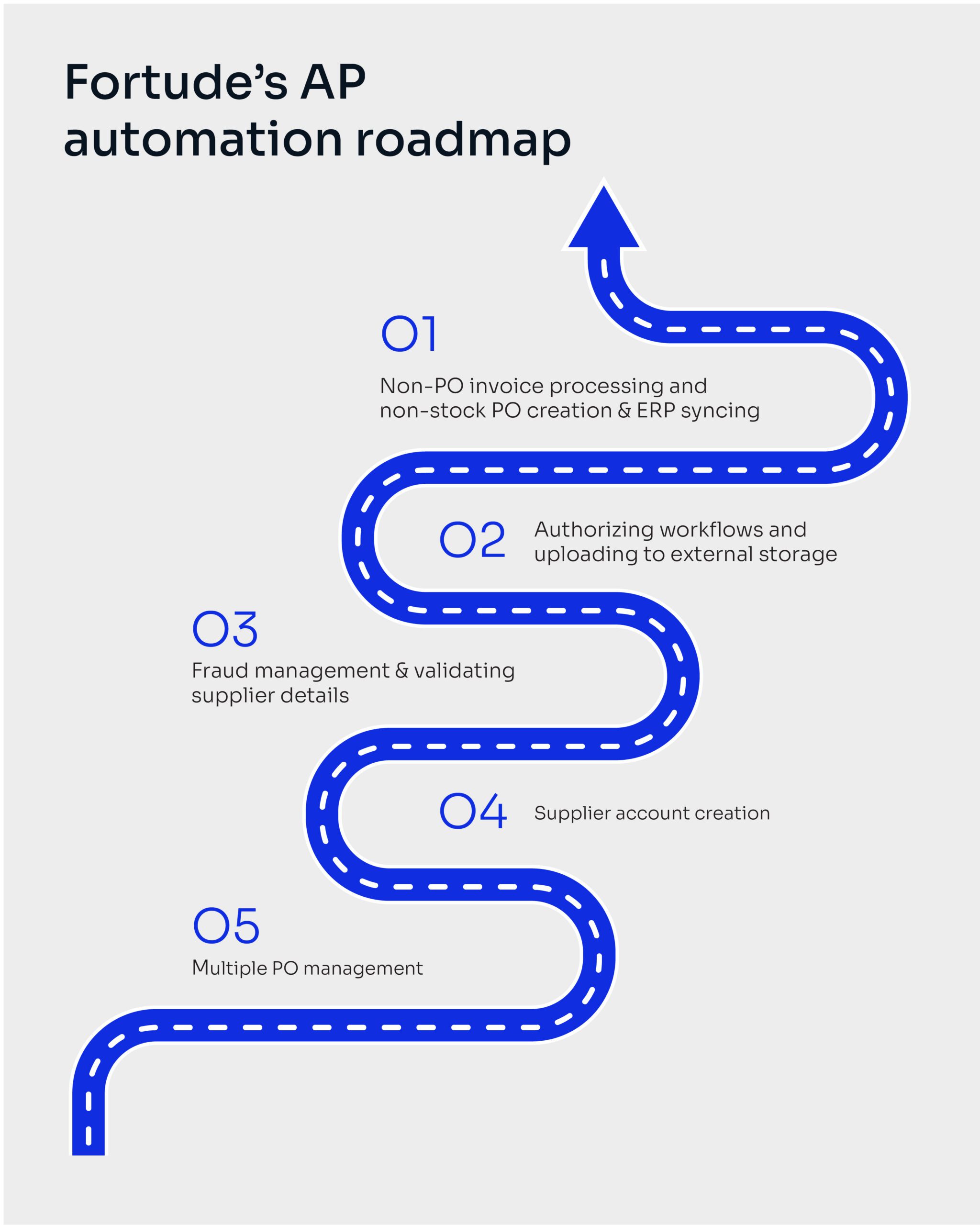
To bridge the gap between basic tools and true transformation, finance teams need a structured framework. Rather than trying to implement agentic AI overnight, Fortude’s approach focuses on mastering the core pillars of modern account processing.
- Non-PO & non-stock PO processing: Automate the heavy lifting of syncing non-standard invoices directly with your ERP without manual data entry.
- Authorizing workflows & external storage: Move approvals out of cluttered email inboxes and into secure, connected digital storage workflows.
- Fraud management & supplier validation: Protect financial governance with automated vendor checks, identifying anomalies before payments are made.
- Supplier account creation: Eliminate onboarding bottlenecks by digitizing and automating the setup of new vendor profiles.
- Multiple PO management: Seamlessly handle complex invoices that span multiple purchase orders without breaking the workflow.
Why you shouldn't jump straight to agentic AI
The temptation is completely understandable. If AI agents can reason, make decisions, and take independent action, why not deploy them straight into the accounts payable process?
The short answer: Autonomy amplifies whatever is already there. If your underlying process is fragmented, your data is unreliable, or your governance is unclear, an agent will not fix those weaknesses; it will just make them harder to control.
- Weak foundations produce unreliable decisions
An AI agent investigating an invoice exception is only as reliable as the information it can access and the rules surrounding it. Poor-quality supplier data, inconsistent invoice formatting, or fragmented process logs can lead to unpredictable, inaccurate outputs. The risks are particularly significant in finance, where systems must operate within strict boundaries and where wrong actions have a direct financial impact.
- Disconnected systems limit true autonomy
An agent can only orchestrate what it can physically access. If invoice, procurement, supplier, and ERP information sit across siloed applications that do not communicate, an agent might identify a problem without having the cross-system context or access needed to resolve it. Seamless integration is not a technical detail that can be added later; it is the foundation for meaningful autonomy.
- Governance becomes more critical as AI takes action
Traditional automation generally stops the moment a rule is broken. An agent, however, can potentially decide what to do next. This fundamentally changes your governance strategy. Finance teams must establish exactly what an agent is allowed to do, when human approval is required, what decisions it made, and how those actions can be traced during an audit.
- Trust must be earned over time
The transition from automation to autonomy should be a gradual, phased evolution. Teams need visible evidence that the underlying process is stable, exceptions are being routed correctly, and automated guardrails are effective before they hand over broader decision-making authority.
The goal is not to avoid agentic AI altogether. It is to ensure your organization is actually ready for it when you flip the switch.
What this looks like in practice
A real implementation shows why that groundwork matters.
Fortude recently built an AP automation solution for an Australian designer and supplier of customized aluminum window and door systems. Facing rapidly growing invoice volumes, their manual processing methods were slowing down payments, straining supplier relationships, and making financial governance difficult to maintain.
Instead of jumping straight to experimental AI agents, we focused on building a robust, connected digital workflow. The results completely transformed their day-to-day operations:
- Instantaneous intake and extraction: By establishing a dedicated digital intake point, incoming invoices are now captured automatically using OCR and AI-assisted data extraction. This eliminated the need for the finance team to manually monitor inboxes and type out line-item data.
- Proactive exception management: The system now automatically cross-references PO verification, supplier information, and duplicate invoices against strict business rules. Instead of reviewing every single invoice by hand, the finance team only steps in when an exception is flagged, allowing them to focus their expertise where it is genuinely needed.
- Seamless ERP synchronization: Validated invoices are now created directly within their ERP in real time, accompanied by a complete digital footprint of the processing journey.
- Complete financial governance: Centralized dashboards give leadership total visibility into what is being processed, what requires attention, and where invoices sit in the workflow, all secured by role-based access controls.
This is exactly the kind of structural foundation that makes the next step possible. This organization didn’t just buy a tool to extract invoice text; they built a connected process with defined rules, tightly integrated systems, and rock-solid governance.
Where this leaves finance teams
The path to agentic AI in finance moves through clear steps from capture and matching to machine learning and reasoning with clean data and integrated systems at every stage. Skip ahead and the risks, weak data, ungoverned agents, systems that can’t talk to each other, show up fast.
The invoice processing solution we built shows what solid groundwork looks like in practice. Getting there first paves the way for agentic AI as the next step.
If your finance team is still processing invoices manually, or you are weighing what agentic AI actually requires before it delivers, let’s talk.