Explore tailored services designed to solve business challenges and support growth
Discover industry-focused expertise built to meet unique business needs
Meet our service partners who strengthen delivery and support client success
Meet our service partners who enhance our capabilities, strengthen service delivery, and help drive successful outcomes for our clients.

Discover how HamiltonJet is exploring secure, practical agentic AI to unlock new opportunities within Infor M3.
Discover how a global manufacturer optimized ERP operations, reduced inventory counting time from one week to one day, and built a roadmap for digital transformation.
Explore our digital products built to streamline work and drive growth every day
Meet our product partners who enhance our solutions and expand client value

Explore a better way to speed up testing and improve release quality.
Access blogs, case studies, events, and insights that support smarter decisions.
BLOG
CASE STUDY
We believe in creating a global workplace where everyone can grow. This is amplified by our teams, who say the best thing about Fortude is our culture, one that is brought to life by a diverse team that spans across continents.
Learn who we are, what we do, and the values that drive our growth
Stay updated with Fortude news, events, stories, and company highlights.
Get in touch with our team to ask questions or start a conversation
Your nearest office- Sri Lanka
Fortude (Pvt) Ltd
146 Kynsey Road, Colombo 7, Sri Lanka
Email – talk-to-us@fortude.co
Phone – +94 11 453 1531
Every day, we bring together diverse perspectives, strong leadership and responsible thinking to build a business that creates lasting value for our clients, people and communities.
Your nearest office- Sri Lanka
Fortude (Pvt) Ltd
146 Kynsey Road, Colombo 7, Sri Lanka
Email – talk-to-us@fortude.co
Phone – +94 11 453 1531
The conversation around accounts payable automation has changed. For years, the goal was straightforward: digitize invoices, extract the data and route them through predefined workflows. Now, as AI agents enter finance operations, the goal moves higher. Agents are now expected to investigate exceptions, coordinate actions across systems and move invoices forward with less human intervention.
But that introduces a more practical question: does the financial case stack up?
That is where Accounts Payable Automation ROI matters. Rather than asking how much of AP can be automated, finance teams need to understand what that automation costs, which expenses it removes, and whether the investment creates measurable value.
The financial return comes from removing process friction at scale, not simply replacing people.
For many finance teams, the biggest opportunities sit across areas such as:
APQC defines total AP processing cost as including personnel, systems, overhead, outsourced and other costs. Its current cross-company benchmark reports a median cost of $6 per invoice across a sample of 5,846 organizations. APQC’s methodology provides a useful starting point, although every enterprise should calculate its own baseline.
The true cost of agentic AP automation includes the technology, implementation, integration, governance and internal effort required to get it operating reliably, not simply an AI license.
A realistic business case should account for:
This matters because calculating ROI against software cost alone creates an artificially attractive number.

Start with the current process, calculate the fully loaded future-state cost, and measure only benefits that can be credibly attributed to the change.
A basic formula:
ROI = (Total benefits – Total investment) ÷ Total investment × 100
For AP, we recommend building the model in four steps.
Measure:
Do this before implementation. Without a reliable baseline, proving realized ROI later becomes difficult.
Include one-time implementation costs alongside recurring platform, integration, support and governance costs.
For agentic AI specifically, finance should also consider the cost of monitoring agent actions, managing permissions and maintaining appropriate human oversight.
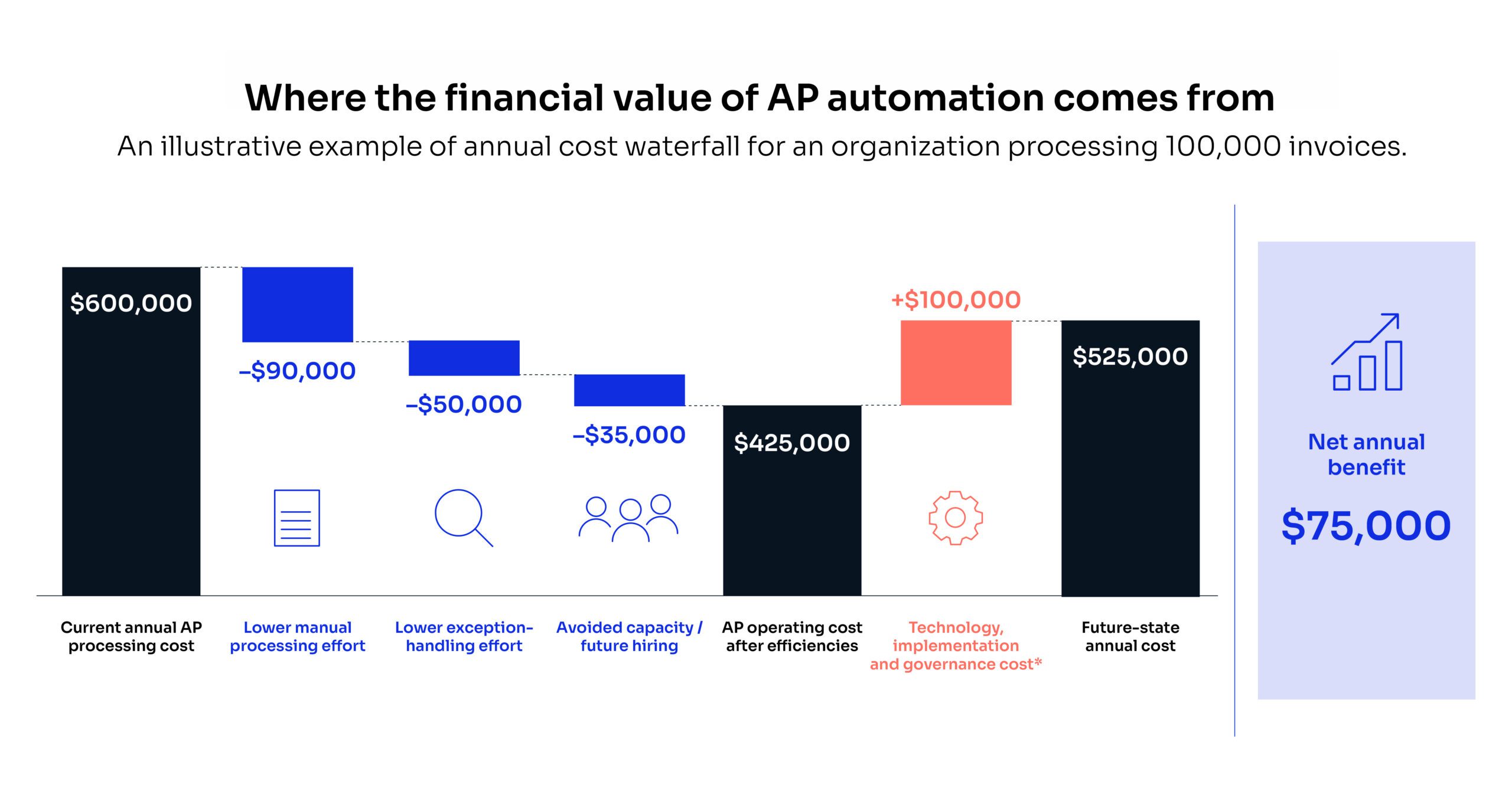
Suppose an organization processes 100,000 invoices annually at an all-in cost of $6 per invoice. That represents $600,000 in annual processing cost.
If automation brings that figure to an illustrative $4.25, annual process savings would be $175,000.
If the three-year cost of implementation and operation were $300,000 and three-year gross benefits were $525,000:
Three-year ROI = ($525,000 – $300,000) ÷ $300,000 = 75%
The figures are illustrative, but the approach is the important part.
If reduced labor is already reflected in the lower cost per invoice, for example, it should not be counted again as a separate benefit.
Build conservative, expected and upside cases.
The conservative case is particularly important for executive approval: What happens if automation rates are lower than planned? What if integrations cost more? What if exception volumes fall by only 20% rather than 50%?
A business case that still works under restrained assumptions is far more useful than one built around a best-case ROI headline.
Traditional automation is strongest when the process follows predefined rules. AI agents potentially create incremental value where work requires context, investigation and a sequence of actions.
For example, if there’s a mismatch in the total in an invoice, traditional automation will fail the match, flag the exception and drop it into an analyst’s queue. From there, the investigation is manual, taking days to sort out. But with an AI agent the same investigation can be run within governed boundaries. It pulls the PO and goods receipts from the ERP, checks procurement for an approved price change, and searches emails for supplier confirmation. It then takes the next step the rules allow, such as routing the invoice to the right approver with the evidence attached. If the evidence is unclear, only then does it escalate to an analyst with a summary of what it found.
Traditional AP automation
Agentic AP automation
Extracts invoice data
Interprets invoice and surrounding context
Matches against configured rules
Investigates why a mismatch occurred
Flags exceptions
Can gather information needed to resolve them
Routes invoices
Can coordinate actions across multiple systems
Requires predefined paths
Can determine a next step within governed boundaries
This distinction matters financially.
In our earlier deep dive into driving end-to-end transformation with optical character recognition (OCR) automation, we looked at the path from OCR through matching, machine learning, reasoning and ultimately agentic orchestration. The point was that organizations should not jump to agents without the data, integration and governance foundations underneath them.
The ROI case follows the same logic. If standard workflow automation already handles 95% of an organization’s invoices economically, adding agents simply because they are newer technology may create little incremental value.
Where exceptions, cross-system investigation and manual follow-up still consume significant finance capacity, the equation can look very different.
Touchless processing is useful, but it does not tell a CFO whether AP has become economically better.
Track a combination of operational and financial measures:
Metric
What it tells finance
Cost per invoice
Whether unit economics are improving
Straight-through processing rate
How much work proceeds without intervention
Exception rate
How often automation breaks
Exception resolution time
How expensive complex invoices remain
Approval cycle time
Whether invoices move faster
Invoices per AP FTE
Whether team capacity is increasing
Rework/error rate
Whether automation improves process quality
It depends on whether there is enough volume, complexity and manual decision-making for an agent to remove meaningful work. The case is typically stronger when:
It may be weaker when volumes are low, processes are already highly efficient, source data is unreliable or the integration work required outweighs the likely benefit. That is why an ROI assessment should come before the technology decision.
In our work building an intelligent invoice processing solution for an Australian designer and supplier of customized aluminium systems, the solution automated invoice intake, OCR-based extraction, business-rule validation, exception routing and ERP creation.
No financial ROI figure was published, but the solution created what any ROI case needs: visibility into what enters automatically, what fails validation, where human intervention occurs and how long each step takes. With that baseline, the next question becomes specific: how much of the remaining manual work can an agent safely and economically remove?
For organizations evaluating that next step, Fortude’s AI and Digital Advisory services can help identify viable use cases, assess readiness and shape an implementation roadmap. Our agentic AI solutions are designed to connect intelligence with enterprise systems and workflows while maintaining the governance required for business-critical processes.
If your AP team has already automated the obvious work but manual exceptions are still absorbing time and cost, talk to Fortude about assessing where AI agents can create measurable value.