Service Offerings

Explore tailored services designed to solve business challenges and support growth

Industries

Discover industry-focused expertise built to meet unique business needs

Partners

Meet our service partners who strengthen delivery and support client success

Meet our service partners who enhance our capabilities, strengthen service delivery, and help drive successful outcomes for our clients.

Learn how to modernize data foundations to enable trusted, scalable AI.

Global supply chain leader in apparel embarks on unified analytics strategy with Microsoft Fabric

See how a unified data strategy built faster insights and scaled analytics.

Products

Explore our digital products built to streamline work and drive growth every day

Partners

Meet our product partners who enhance our solutions and expand client value

AI-powered automated
 regression testing: Your
kickstart for 2026

Explore a better way to speed up testing and improve release quality.

Resources

Access blogs, case studies, events, and insights that support smarter decisions.

Latest Resources

CASE STUDY

HamiltonJet transforms regression testing on Infor CloudSuite with Fortest

NEWS

Fortude earns Microsoft Azure Infrastructure Solutions designation

Our People

Discover a culture where you can grow and shape what’s next

Everyone can grow at Fortude

We believe in creating a global workplace where everyone can grow. This is amplified by our teams, who say the best thing about Fortude is our culture, one that is brought to life by a diverse team that spans across continents.

Latest

Fortude builds momentum for women in tech with all-female Ignite 2.0 tech internship

Aug 22, 2025

Pioneering innovation and inculcating learning in the age of AI

Aug 01, 2024

About Us

Learn who we are, what we do, and the values that drive our growth

News & Events

Stay updated with Fortude news, events, stories, and company highlights.

Contact Us

Get in touch with our team to ask questions or start a conversation

Your nearest office- Sri Lanka

Fortude (Pvt) Ltd
146 Kynsey Road, Colombo 7, Sri Lanka

Email – talk-to-us@fortude.co
Phone – +94 11 453 1531

What defines us goes beyond what we do

Every day, we bring together diverse perspectives, strong leadership and responsible thinking to build a business that creates lasting value for our clients, people and communities.

Fortude disrupts ERP delivery with agentic AI across the Infor CloudSuite lifecycle

Office locations

Agentic AI solutions

8 agentic AI use cases transforming enterprise operations

11 min read

September 17, 2026

Share

  • Agentic AI is most valuable when a decision depends on information spread across several systems.
  • The business case should connect to revenue, margin, working capital, customer service, or operational risk.
  • AI agents should gather evidence and recommend action, not simply summarize information.
  • Material actions still require defined approvals and clear ownership.
  • The eight examples in this article represent base-agent foundations that can be shaped around specific business processes and decision requirements.
  • Enterprises should begin with one recurring, measurable decision before expanding to wider workflows.

The current enterprise challenge is not the quantity of data, but bringing the right data together efficiently enough to support a decision.

An employee may need to check many factors such as pricing policies, inventory availability, production schedules, and customer commitments before responding to an order exception or spend days combining actuals, budgets, and operational data before explaining a variance.

The most valuable agentic AI use cases address this gap. They help employees investigate changing conditions, evaluate options, and determine the next appropriate action without removing accountability from the people responsible for the decision. In this blog, we look at eight decision scenarios supported by Fortude’s Infor  agents that support  core enterprise functions.

What makes agentic AI relevant to business decisions?

Agentic AI applies reasoning and coordinated action to business situations where the correct response changes according to context.

Traditional automation works well when the rule is fixed. For example, a workflow can send an alert when inventory falls below a set threshold. 

The real decision, however, is rarely that simple. A planner may need to determine whether to replenish the item, transfer stock from another location, wait for an incoming purchase order, or prioritize a high-value customer.

An AI agent can bring together the evidence required for that decision, assess it against business policies, and recommend the most appropriate response.

Approach

Business role

Example

Reporting

Shows what has happened

Lists overdue customer orders

Automation

Executes a predefined rule

Sends an alert after an order passes its due date

Generative AI

Produces an explanation

Summarizes the reasons for late orders

Agentic AI

Investigates and recommends action

Checks stock, production, and logistics data before proposing a response

Which decisions are suitable for agentic AI?

The strongest candidates are recurring decisions where improving speed, information quality, or decision consistency can deliver measurable business value. 

A decision is worth evaluating when:

  • Employees regularly move between ERP, CRM, spreadsheets, and communication platforms to investigate it.
  • Delayed action affects revenue, margin, cash flow, customer service, or operational performance.
  • The evidence required for the decision is available in enterprise systems.
  • Policies can define what the agent may recommend or execute.
  • The outcome can be tracked through a clear KPI.

8 use cases across Fortude’s agents built for Infor systems

Fortude’s Infor  agents are designed around core enterprise functions such as sales, inventory, procurement, manufacturing, supply chain, finance, and customer management. This provides a starting foundation that can be applied to different business decisions and workflows rather than limiting each agent to a single use case.

The eight scenarios below show what that can look like in practice, focusing on the decision being made, the evidence the agent needs, and the business outcome that could improve. 


1. Should a sales order be approved, corrected, or escalated?

A sales agent can help commercial teams respond to pricing exceptions and delivery risks before they affect margin or customer commitments.

Consider a sales order with a discount five percentage points above the customer’s approved tier. A representative may not notice the exception immediately, particularly when pricing policies and order details sit in separate screens.

The agent can retrieve the order, compare the proposed discount with the relevant policy, calculate the commercial impact, and route the exception to the appropriate manager.

  • Decision: Approve, reject, or revise the order terms based on user input.
  • Evidence: Customer tier, order value, expected margin, discount policy, order history, and approval limits.
  • Measures: Margin leakage, approval time, order-cycle time, and policy compliance.


2. Should inventory be replenished, transferred, or allowed to decrease?

An Inventory Agent can help planners determine the right response to a predicted stock shortage.

A low-stock alert does not explain whether an item will run out or what should happen next. The planner must consider demand, open orders, incoming supply, lead times, safety stock, and inventory held at other locations.

The agent can monitor these factors continuously. If an item is expected to run out in nine days, it can assess incoming purchase orders, identify available stock elsewhere, and calculate a replenishment recommendation.

  • Decision: Replenish, transfer, substitute, or take no action.
  • Evidence: Stock by warehouse, demand, open customer orders, incoming supply, safety stock, and lead times.
  • Measures: Stockouts, excess inventory, inventory turns, working capital, and order-fill rate.


3. Which supplier should receive the purchase order?

A Procurement Agent can help sourcing teams compare suppliers on total business impact rather than price alone.

The lowest-priced supplier may have longer lead times, inconsistent quality, declining delivery performance, or an expiring contract. These factors are often reviewed separately or discovered only after the sourcing decision has been made.

The agent can combine supplier scorecards, purchase history, contract terms, quality records, and approved external risk information. It can then present the trade-offs behind each option.

  • Decision: Select a supplier, negotiate different terms, renew a contract, or escalate a risk.
  • Evidence: Price, lead time, quality, delivery history, capacity, contract status, and supplier risk.
  • Measures: Purchase-price variance, supplier delivery performance, quality incidents, unmanaged spend, and disruption frequency.


4. Should the production schedule be changed?

A Manufacturing Agent can identify whether emerging production risks justify rescheduling, maintenance, or capacity changes.

Schedule slippage is often recognized after production has missed its target. By then, affected customer orders may already be at risk.

The agent can monitor production progress, maintenance history, quality holds, and order priorities. When a line begins falling behind, it can identify the affected orders and compare options such as resequencing work, reallocating capacity, or escalating maintenance.

  • Decision: Continue, reschedule, reroute, or intervene.
  • Evidence: Schedule status, machine condition, maintenance history, quality holds, labor availability, and customer priority.
  • Measures: Schedule adherence, downtime, throughput, quality losses, and on-time completion.


5. Should a delayed shipment be expedited or rerouted?

A Supply Chain Agent can help teams choose the most commercially appropriate response to a logistics disruption.

A carrier delay does not automatically justify an expedited request. The decision depends on the delivery commitment, available inventory, alternative routes, customer importance, and the cost of mitigation.

The agent can detect the delay, compare response options, and route cost-bearing recommendations for approval. It can also provide the sales team with the same operational context so that customers receive accurate information early.

  • Decision: Wait, reroute, expedite, reallocate stock.
  • Evidence: Carrier status, delivery promise, alternative routes, available stock, customer priority, and mitigation cost.
  • Measures: On-time-in-full delivery, expedite cost, response time, and customer-service performance.


6. Which financial variance requires management action?

A Financial Planning & Analysis (FP&A) Agent can help finance teams distinguish a material business issue from a normal reporting variance.

Analysts often spend much of the reporting cycle gathering actuals, budgets, forecasts, and supporting operational data. This leaves less time to explain what changed and what management should do.

The agent can assemble the relevant data, identify the largest drivers, and prepare an initial decision-focused narrative. It can show whether a variance was caused by price, volume, timing, productivity, or an isolated event.

  • Decision: Revise the forecast, control spending, reallocate budget, or investigate further.
  • Evidence: Actuals, budget, forecast, cost-center data, historical trends, and operational drivers.
  • Measures: Forecast accuracy, reporting-cycle time, analyst effort, and budget variance.


7. Which customer or opportunity needs attention first?

A Customer Relationship Management (CRM) Agent can help sales teams prioritize accounts based on risk, commercial value, and the likelihood that action will make a difference.

Representatives cannot review every account, opportunity, service issue, and renewal each day. Important signals may remain unnoticed until a deal stalls or a customer decides not to renew.

The agent can rank accounts requiring attention and prepare a briefing before scheduled meetings. It can combine recent interactions, order history, open service cases, pipeline activity, and renewal dates.

  • Decision: Which account to contact, what issue to address, and what action to take next.
  • Evidence: Engagement, account activity, pipeline stage, service cases, order history, and renewal timing.
  • Measures: Win rate, renewal rate, pipeline velocity, churn, and selling time.


8. Which payment exception should finance resolve first?

An Accounts Payable / Accounts Receivable (AP/AR) Agent can help finance teams prioritize exceptions according to value, ageing, risk, and cash-flow impact.

Not every unmatched payment or overdue invoice requires the same level of attention. A high-value customer payment awaiting reconciliation may be more urgent than a routine exception with limited financial impact.

The agent can compare bank and ERP records, resolve straightforward matches, and route unresolved cases to the appropriate controller with the supporting evidence already assembled.

  • Decision: Match, escalate, follow up, approve, or investigate.
  • Evidence: Invoice value, ageing, payment reference, customer history, supplier status, and approval policy.
  • Measures: Days Sales Outstanding, reconciliation effort, overdue balances, invoice-cycle time, and payment accuracy.


How do connected agents support cross-functional decisions?

The greatest value comes when agents share approved context across functions rather than improving one department in isolation.

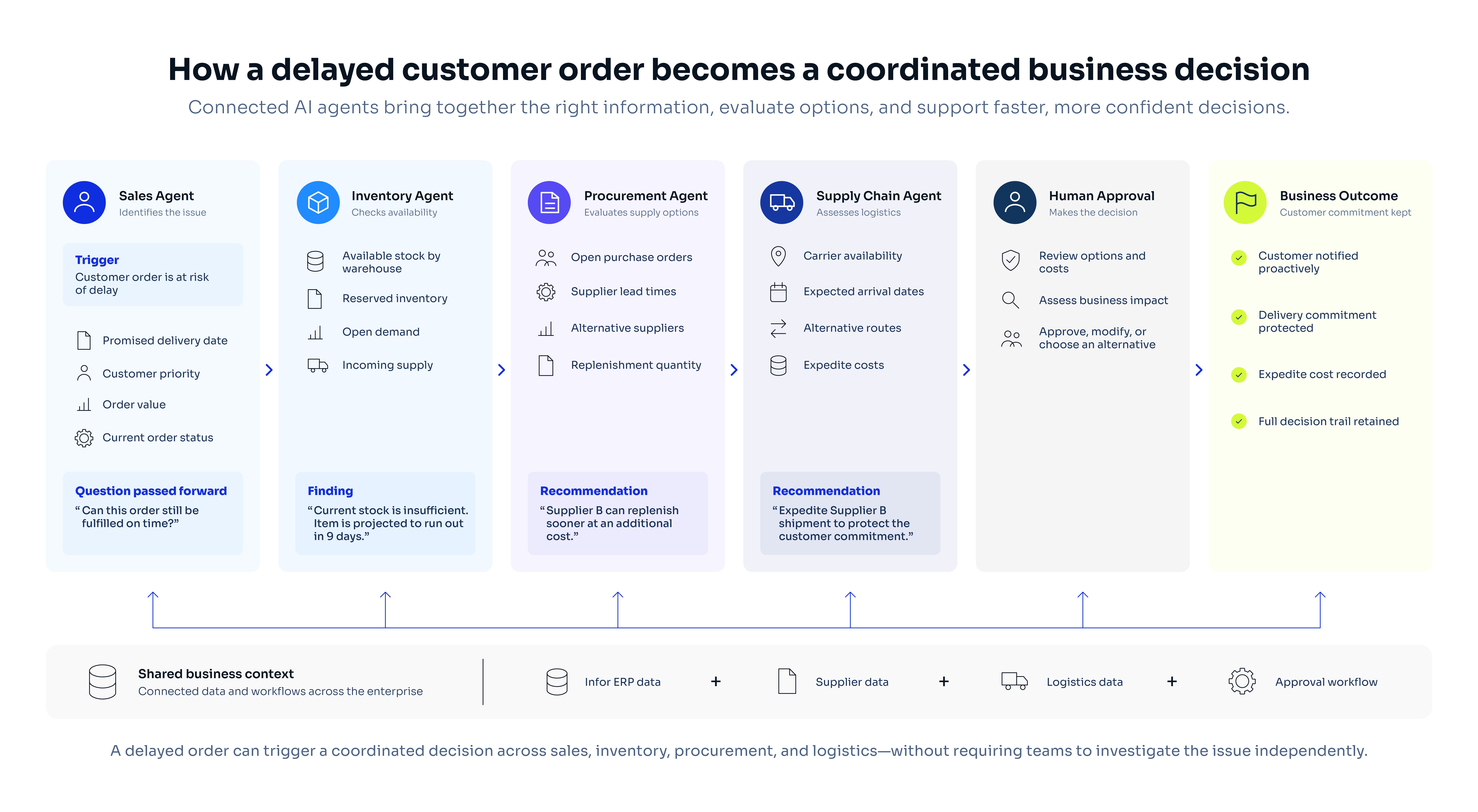
A sales agent investigating a delayed order may request inventory information. The inventory agent may identify a shortage and provide a replenishment requirement to procurement. A supply chain agent can then determine whether incoming stock will arrive before the customer’s committed date. This creates a coordinated decision path across sales, inventory, procurement, and logistics.

Fortude’s MCP Server can support this approach by providing a standardized way for AI applications to interact with approved enterprise data and workflows. Shared connectors can also support approvals, messaging, and audit records across several agents.

Connected Sales, Inventory, Procurement, and Supply Chain agents gathering evidence to support a delayed order decision.

What does this look like in a business environment?

Fortude worked with an Australian brand distributor using Infor M3 and Microsoft Fabric. Employees previously had to move between operational and analytical systems and often rely on specialist knowledge to answer business questions.

Fortude introduced an Infor MCP Agent for live ERP interactions and a Microsoft Fabric Data Agent for analytical queries. An orchestration layer directs requests to the appropriate agent, helping employees investigate supply-chain conditions through a more unified experience.

Which business decision should you address first?

Start with a decision that is frequent, costly when delayed, supported by available data, and measurable through an operational or financial KPI.

Evaluation area

Leadership question

Business impact

What does a delayed or inconsistent decision currently cost?

Frequency

How often does the situation occur?

Decision time

How long does the investigation take today?

Data readiness

Is the required evidence current and reliable?

Governance

Which actions require human approval?

Measurement

Which KPI should improve?

Avoid starting with the broad objective of deploying AI across the enterprise. Start with a defined decision, such as reducing discount leakage, preventing stockouts, prioritizing payment exceptions, or identifying production risks sooner.

Is agentic AI worth the investment?

It is worth evaluating when it improves the speed, consistency, or quality of an important business decision.

The decision should not depend on how many conversations an agent handles. It should depend on outcomes: fewer missed orders, lower working capital, faster financial analysis, improved margins, reduced downtime, or earlier risk detection.

Fortude’s enterprise AI agents connect AI-driven interaction with ERP, analytics, and operational workflows. A practical first step is to identify one recurring decision, map the required evidence, define approval boundaries, and establish the KPI expected to improve.

Ready to identify where AI agents could make the biggest difference to your business decisions? Talk with Fortude experts to assess and prioritize the opportunities with the clearest path to measurable value.

CONTENTS

Receive the latest
Fortude Newsletter
updates.

Share

Related Blogs