Introduction
Agentic AI represents a big leap in technology; it’s the shift from reactive tools that simply answer questions to truly autonomous agents that can perceive their environment, make decisions, and take proactive actions to achieve specific goals. Unlike older systems, agentic AI uses complex decision-making frameworks and often works within multi-agent systems (MAS), where specialized agents collaborate on complex workflows to maximize efficiency and scalability.
What is supply chain transparency?
The terms “transparency” and “visibility” are often used interchangeably, and their definitions differ across industries and organizations. Though often used interchangeably, visibility has a slightly different connotation. Traceability is a closely related concept.
Transparency
Transparency is making all information regarding the products and processes available to all stakeholders: consumers, partners, shareholders, and regulatory bodies.
Visibility
Visibility allows stakeholders to closely examine a product or a process at a particular link or a touchpoint in the supply chain. stakeholders: consumers, partners, shareholders, and regulatory bodies.
Traceability
Supply chain traceability is the ability to track the origin and journey of products, from sourcing and manufacturing to consumption, the end of the supply chain.
Meet consumer demand for transparent food supply chains
Today’s consumers are conscientious. They are motivated by health, wellbeing, and social issues and consider nutrition information, actual benefits, visibility into suppliers, treatment of animals, and environmental sustainability — and these motivations affect their buying decisions.
A culmination of this new thinking behavior is the farm-to-table social movement, which expects organically grown, fresh, local produce. These expectations put a lot of pressure on food and beverage companies. If a company fails to satisfy these needs, consumers have multiple alternatives to choose from: the competition is high.
Agentic AI represents a big leap in technology; it’s the shift from reactive tools that simply answer questions to truly autonomous agents that can perceive their environment, make decisions, and take proactive actions to achieve specific goals. Unlike older systems, agentic AI uses complex decision-making frameworks and often works within multi-agent systems (MAS), where specialized agents collaborate on complex workflows to maximize efficiency and scalability.
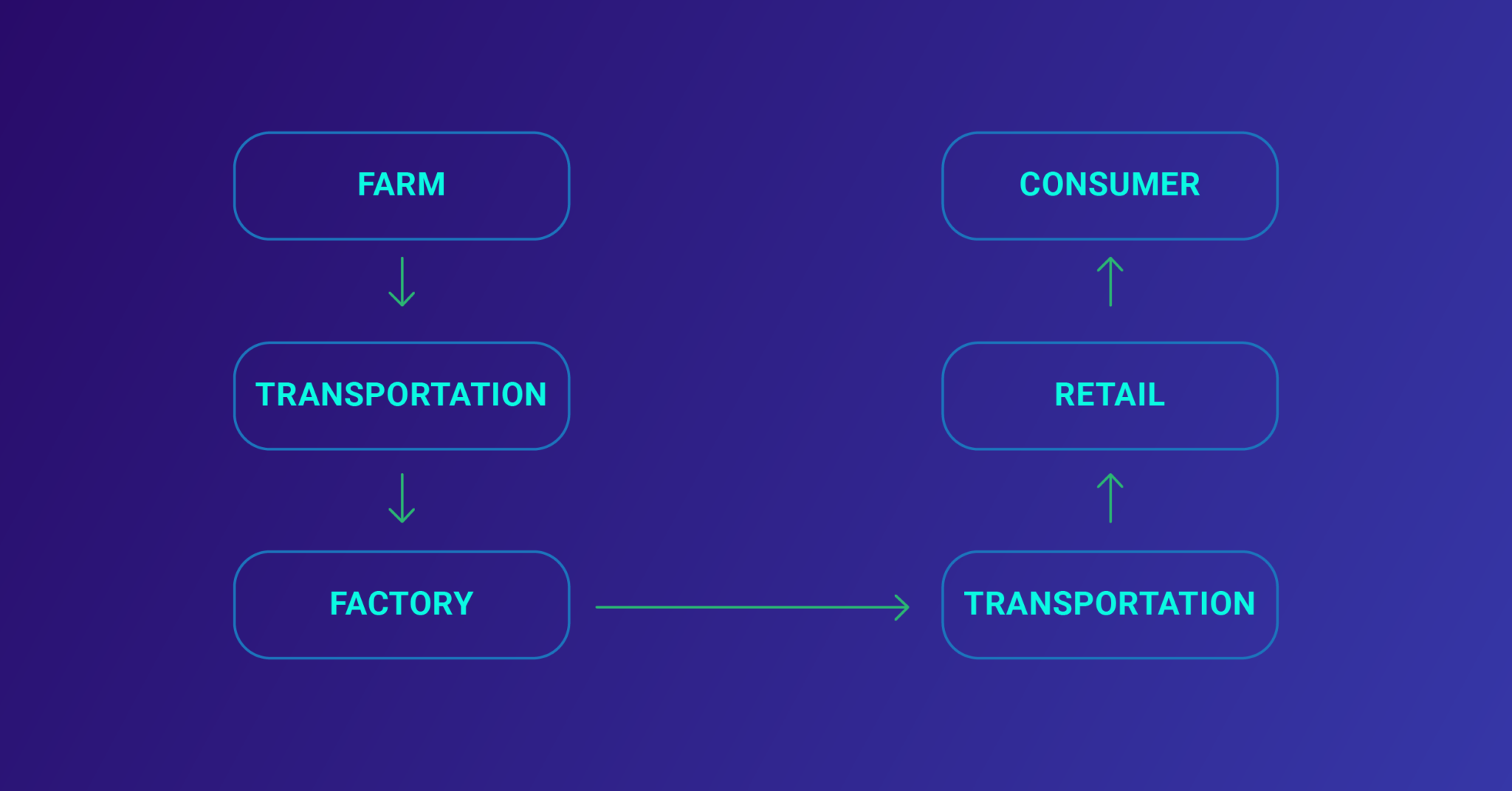
Figure 1: Farm to table process
Transparency is extremely important or important to 81% of shoppers both online and at brick-and-mortar stores, according to Transparency Trends: Omnichannel Grocery Shopping from the Consumer Perspective, a report published by FMI and Label Insights, a product transparency market leader.
Supply chain transparency is an important differentiator, especially for food and beverage manufacturers and retailers. It helps build brand loyalty and trust.
Identifying and responding to food safety issues
Meeting compliance and regulatory requirements
Public health is a high priority for governments and policymakers. Newer regulations require agile responses to food recalls and the manufacturer’s ability to trace products quickly. For example, under the Food Safety Modernization Act of 2011, the US FDA will have the authority to require traceability for selected high-risk food items. Australia’s National Livestock Identification System (NLIS) mandates the identification and traceability of cattle, sheep, and goats throughout their lifespan. European Food Safety Authority has laid down similar measures.
Also, regulations change often; having supply chain transparency and traceability enables manufacturers to adapt to new regulations and provide the information required for doing business with new markets, quickly.
Sustainability beyond the farm
While sustainable and environment-friendly farming practices play a critical role, sustainability matters beyond the farm, throughout the food supply chain.
The sustainability goals in the food supply chain are under challenge due to the growing world population and resource scarcity. Adding to the woe, if ecosystems continue to degrade at the current rate, we will soon reach a point of no return.
On the farm, food manufacturers practice crop rotation to preserve soil health and to prevent soil erosion. Methane, a greenhouse gas emitted by dairy cows, affects the earth’s temperature and climate stability. A 2015 study showed that adding seaweed to cattle feed can significantly cut down methane emissions. Similarly, many novel technologies have been implemented to improve sustainability during transportation, warehousing, and retail.
For F&B companies, sustainability is no longer a trend but a business imperative for better profitability, long-term viability, and, most importantly, to safeguard the wellbeing of consumers. And to identify, plan, implement and optimize sustainable practices throughout the food supply chain, transparency and visibility play a key role.
In the next blog post, let’s explore how enterprises can use the cloud, business intelligence, analytics, and Industry 4.0 technologies to improve visibility, transparency, and traceability across the food supply chain.
References:
- Estimating Food Waste as Household Production Inefficiency, American Journal of Agricultural Economics
- Best Practice Guide: Improving supply chain transparency in modern food and beverage manufacturing, Infor
- Report: Incentivizing Food Systems Transformation, World Economic Forum in collaboration with McKinsey & Company