ERP go-lives rarely fail because the software breaks. They fail because the business cannot operate on the data within it.
A data migration testing strategy is not just a technical checklist. In an ERP rollout, it is the control framework that verifies whether critical business data such as customers, suppliers, items, inventory, open orders, balances, pricing, costs, production data, and integrations can move into the new system without disrupting operations.
This is important because ERP programs still carry high execution risk. Gartner notes that more than 70% of recently implemented ERP initiatives fail to fully meet original business-case goals, with up to 25% failing catastrophically. One practical reason is poor data quality. IBM identifies inconsistency, missing data, and outdated data as common indicators of poor-quality data. Salesforce’s 2026 data and analytics research also reports that data leaders estimate 26% of organizational data is untrustworthy.
Against this backdrop, a structured data migration testing strategy becomes one of the most important safeguards in a successful ERP implementation. This blog explains what that strategy looks like in practice.
What is a data migration testing strategy in an ERP rollout?
A data migration testing strategy defines how an enterprise will validate data before, during, and after ERP migration so the new system can support live business processes from day one.
For ERP rollouts, this means testing more than record counts. For example, a customer’s master data may get migrated successfully at field level, but if credit limits, tax codes, EDI settings, or ship-to relationships are wrong, order processing can fail.
A strong strategy should validate:
- Completeness: Did all required records move?
- Accuracy: Do values match approved business rules?
- Integrity: Are relationships preserved?
- Reconciliation: Do financial and operational totals align?
- Usability: Can users transact with migrated data?
- Continuity: Can the business operate during and after cutover?
How does ERP data migration testing affect business continuity?
ERP data migration testing protects business continuity because ERP data directly drives purchasing, production, inventory, finance, sales, service, and compliance.
While a migration defect in a reporting database may affect dashboards, a migration defect in ERP can stop order fulfillment, delay invoicing, distort stock availability, or misstate financial balances.
The highest-risk ERP data areas usually include:
A good data migration testing strategy reduces these risks by testing the data in context. For example, it is not enough to confirm that item records are loaded. The business must confirm that those items can be planned, purchased, manufactured, sold, shipped, invoiced, reported, and reconciled. This is why a data migration testing strategy should be owned jointly by IT, finance, operations, supply chain, and business process owners instead of just the data migration team.
When should data migration testing start?
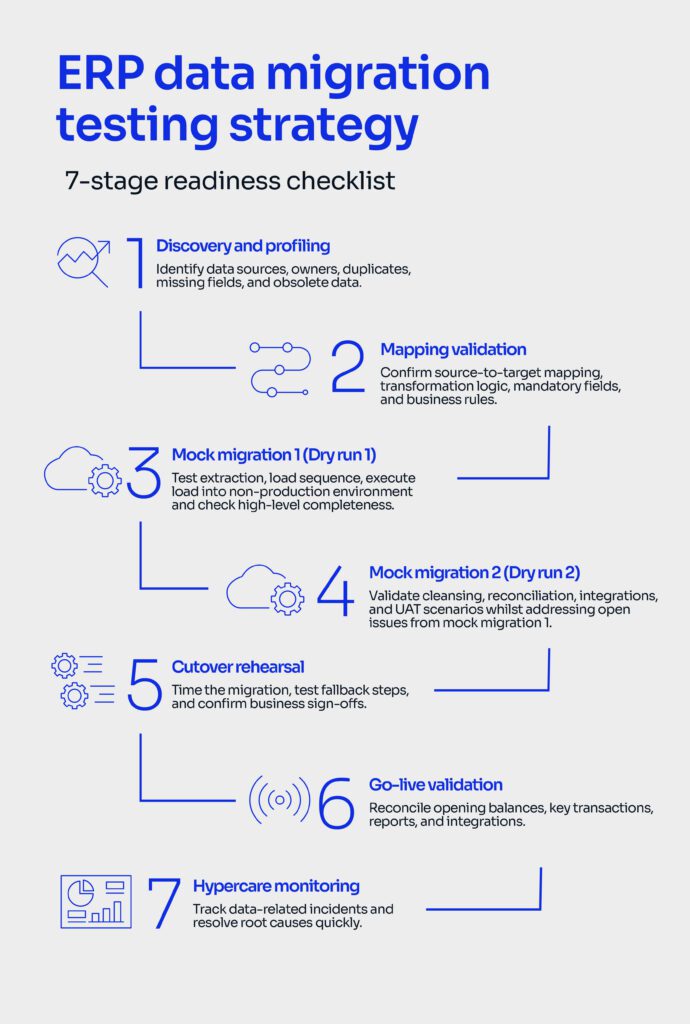
Data migration testing should start as early as during ERP design, instead of during cutover. The best time to identify data issues is before configuration is locked and before users begin UAT (User Acceptance Testing). Waiting until the final mock migration, might be too late as it often creates a false choice between delaying go-live and accepting operational risk.
A practical ERP testing timeline for data migration looks like this:
Phased rollout vs big bang: Which migration approach works better?
A phased rollout lowers enterprise-wide risk but increases the need for interim integration, reconciliation, and coexistence between the old system and the new system . A big-bang rollout reduces coexistence complexity but raises cutover & post go-live support pressure.
Case study: Protecting continuity during a multi-site ERP rollout
One of the UK’s largest chilled food manufacturers engaged with Fortude in early 2025 as part of a broader ERP transformation program. The organization was scaling through acquisitions and needed a delivery partner to accelerate multi-site ERP rollouts while adapting a core template to site-specific needs.
The business was operating on legacy M3 v7 across multiple entities. This created fragmented processes, limited group-level visibility, and challenges in scaling operations consistently.
Role played by Fortude:
- Supported the rollout of Infor M3 CloudSuite using a standardized business template
- Addressed data migration challenges such as inconsistencies across legacy datasets. This was done through structured templates, iterative cleansing, validation cycles, and business sign-off.
- Designed a finance data bridge to synchronize General Ledger (GL), Accounts Receivable (AR), and Accounts Payable (AP) transactions from the legacy environment to the cloud Enterprise Resource Planning (ERP) daily.
The impact was practical and measurable:
- Finance operations continued without major disruption.
- Financial data remained aligned across systems.
- The phased rollout could proceed without waiting for full migration.
- The pilot site went live and stabilized successfully.
- Customer service levels stayed above 98% during hypercare.
This case shows why a data migration strategy should include coexistence testing, not only one-time migration testing. Fortude’s ERP consulting work spans across Infor CloudSuite and Microsoft Dynamics 365 Business Central, emphasizing structured implementation, integration, and post-go-live support.
How can automation improve ERP data migration testing?
Automation improves ERP data migration testing by making validation repeatable, faster, and less dependent on manual sampling.
Automation can support:
- Source-to-target comparison
- Record-count validation
- Exception reporting
- Regression testing after configuration changes
- End-to-end process validation
- Integration checks after ERP releases or patches
Planning an ERP rollout or phased migration?
A data migration testing strategy is worth the effort as it supports multiple complex integrations and is one of the strongest safeguards against ERP go-live disruption.Start by treating migration testing as a business continuity workstream.
Speak to Fortude about building a data migration testing and rollout readiness approach that protects business continuity from design to hypercare.