Service Offerings

Explore tailored services designed to solve business challenges and support growth

Industries

Discover industry-focused expertise built to meet unique business needs

Partners

Meet our service partners who strengthen delivery and support client success

Meet our service partners who enhance our capabilities, strengthen service delivery, and help drive successful outcomes for our clients.

Learn how to modernize data foundations to enable trusted, scalable AI.

Global supply chain leader in apparel embarks on unified analytics strategy with Microsoft Fabric

See how a unified data strategy built faster insights and scaled analytics.

Microsoft solutions partner for Data & AI

Products

Explore our digital products built to streamline work and drive growth every day

Partners

Meet our product partners who enhance our solutions and expand client value

AI-powered automated
 regression testing: Your
kickstart for 2026

Explore a better way to speed up testing and improve release quality.

Resources

Access blogs, case studies, events, and insights that support smarter decisions.

Latest Resources

CASE STUDY

HamiltonJet transforms regression testing on Infor CloudSuite with Fortest

NEWS

Fortude earns Microsoft Azure Infrastructure Solutions designation

Our People

Discover a culture where you can grow and shape what’s next

Everyone can grow at Fortude

We believe in creating a global workplace where everyone can grow. This is amplified by our teams, who say the best thing about Fortude is our culture, one that is brought to life by a diverse team that spans across continents.

Latest

Fortude builds momentum for women in tech with all-female Ignite 2.0 tech internship

Aug 22, 2025

Pioneering innovation and inculcating learning in the age of AI

Aug 01, 2024

About us

Learn who we are, what we do, and the values that drive our growth

News & events

Stay updated with Fortude news, events, stories, and company highlights.

Contact us

Get in touch with our team to ask questions or start a conversation

Your nearest office- Sri Lanka

Fortude (Pvt) Ltd
146 Kynsey Road, Colombo 7, Sri Lanka

Email – talk-to-us@fortude.co
Phone – +94 11 453 1531

What defines us goes beyond what we do

Every day, we bring together diverse perspectives, strong leadership and responsible thinking to build a business that creates lasting value for our clients, people and communities.

Fortude secures major Solutions Partner achievement with Analytics on Microsoft Azure Specialization

Office locations

Data & AI

Farm-to-Table Transparency with Industry 4.0

5 MIN READ

June 29, 2021

Share

Introduction

In our last blog post on food supply chain visibility, we talked about why visibility and related concepts such as transparency and traceability matter. In this blog post, we delve into how food and beverage manufacturers and retailers can optimally use Industry 4.0 technologies to achieve and deliver stakeholder expectations concerning visibility, transparency, and traceability.

What is Industry 4.0?

Deloitte defines Industry 4.0 as:

“The marriage of physical and digital technologies such as analytics, artificial intelligence, cognitive technologies, and the Internet of Things (IoT). This marriage of the physical with the digital allows for the creation of a digital enterprise that is not only interconnected, but also capable of more holistic, informed decision making.”

How can food and beverage manufacturers use IoT, analytics, artificial intelligence, and cognitive technologies to increase supply chain transparency?

Internet of Things to Internet of Senses

Internet of Things (IoT) refers to the system of using sensors to capture, analyze, and transmit data from different types of sources over a wireless network without human intervention.

IoT is one of the key technologies that can help food manufacturers track and locate goods and isolate problems. For example, an IoT framework can communicate data from sensors that monitor the humidity and temperature of food items in transit. Connected to an ERP through a data lake, the framework can trigger alerts with regard to unsafe humidity and temperature levels, enabling faster responses and real-time decision making.

A report by Ericsson predicts that IoT will evolve into the ‘Internet of Senses’ by 2030, further extending IoT’s ability to capture sight, smell, taste, touch, and hearing through artificial intelligence (AI), augmented reality (AR), virtual reality (VR), and automation.
Keeping an eye on your machinery

Modern enterprise asset management (EAM) solutions can monitor operational efficiency, safety, and equipment compliance for signs of performance issues, downtime, and maintenance needs.

Having visibility over agricultural and food manufacturing equipment performance can help organizations track production efficiency and be proactive in identifying issues that can lower the quality of produce or compromise food safety.

Transparency beyond packaging

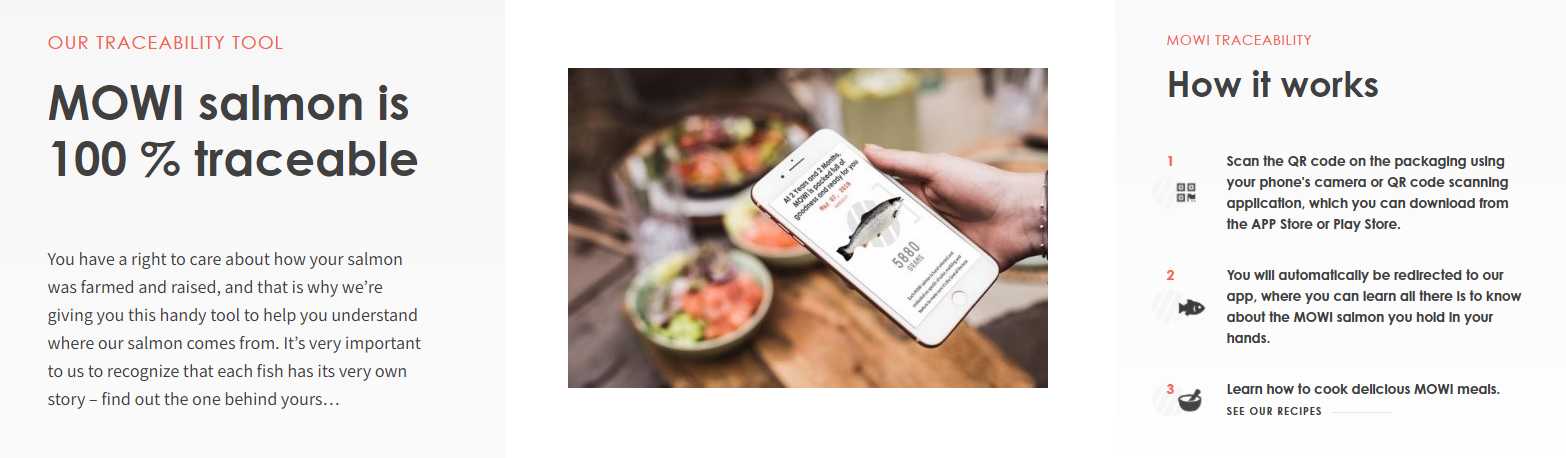
According to Label Insight and the Food Marketing Institute, 75% of consumers say they’re keen to turn to products that provide in-depth information beyond the packaging. Lightweight technologies like QR codes can enable this. When consumers scan a QR code on a food product, they will be directed to in-depth information.

In addition to nutritional information, the consumer can be made aware of the provenance of ingredients, allergens, GMO disclosures, food safety certificates, and even recipes for preparing food.

Figure 1: Snippets from mowisalmon.com explaining their end-to-end product traceability.
Mowi is the largest producer of farmed salmon in the world by volume and revenue.

FAQ

Making sense of the deluge of data with analytics

As F&B companies increase connectivity and visibility along the supply chain, they will accumulate more data. International Data Corporation (IDC) forecasts that by 2025 there will be 55.7 billion connected devices globally, 75% of which will be connected to an IoT framework. IDC estimates IoT devices will generate 73.1 zettabytes of data in 2025, growing from 18.3 zettabytes in 2019.

Food and beverage manufacturers can use an analytics platform to leverage this data to identify process inefficiencies and anticipate trends such as food waste, safety, and productivity fluctuations and make recommendations.

FAQ

Prescriptive intelligence

By coupling artificial intelligence (AI) and cognitive systems with the influx of supply chain data, F&B companies can create solutions that can predict future supply chain issues and prescribe remedies, allowing them to react earlier.

Modern AI platforms can continuously observe end-to-end supply chain data such as flow of ingredients, product movement, orders, demand, and capital and train itself on the patterns and detect port congestions, predict potential stock-outs, and suggest solutions such as shipping goods to a different location or reallocating stock between stores.

The total impact of the 2021 Suez Canal Blockage is estimated to be around $54 billion. With better visibility and the assistance of cognitive technologies, supply chain managers can evaluate the cost-versus-benefits of switching to a different route and execute a plan B.

Modern cognitive systems can even make autonomous decisions without human intervention or prompt a decision-maker to approve the decision before executing such decisions.

FAQ

Rise of blockchain

Blockchain is a secure digital record-keeping technology that can be leveraged to identify and track sequential activities. In the food and beverage industry, blockchain can digitize supply chain information by securely managing records on:

  • The source of ingredients, such as country of origin
  • Producer-specific information, such as the farm or processing facility
  • Product information, such as the date of production and production batch codes
  • Food safety, inspection, and testing certification records
  • Expected shelf-life or “best if used by” dates

Though currently limited to financial markets, leading manufacturers and retailers are considering blockchain to mitigate challenges related to trust, efficiency, and speed in their complex supply chains.

FAQ

A robust ERP in the cloud

A modern ERP solution should have traceability options built in. Usability, the ability to visualize trace lines, and swift connectivity to data sources are few other signs of a traceability-enabled ERP system.

An ERP that is designed specifically to meet the challenges of food & beverage companies should offer out-of-the-box connectors and reports to help F&B companies start quickly. Having the ERP in the cloud also helps F&B companies to start small, scale fast, be agile and be more digital.

FAQ

Conclusion

Many food and beverage manufacturers lack the technical and technological know-how to meet the supply chain visibility demands in today’s highly competitive global business landscape. But the fourth industrial revolution is a journey, not a destination. Organizations can start small and build a framework that can scale and adjust to face the growing demand for transparent food and beverage supply chains.

FAQ

CONTENTS

Introduction
What is Industry 4.0?
Internet of Things to Internet of Senses
Keeping an eye on your machinery
Transparency beyond packaging
Making sense of the deluge of data with analytics
Prescriptive intelligence
Rise of blockchain
A robust ERP in the cloud
Conclusion

Receive the latest
Fortude Newsletter
updates.

Share

Receive the latest
Fortude Newsletter
updates.

Share