

Ending guesswork in customer sentiment with agentic AI


Today, a business’s social presence is possibly more important than its physical presence. While maintaining this presence requires time and effort from dedicated teams, it is equally important to understand public sentiment toward your brand. Monitoring and analyzing this sentiment can be a tedious process, but it no longer has to be. Not if you have the support of an AI agent.
In previous blogs, we explored Fortude’s other AI agents that use signal-based forecasting and inventory optimization for fashion businesses. These agents already apply the principles of Multi-Agent Systems (MAS) to solve some of the industry’s greatest financial drains: inaccurate stock levels and volatile demand.
In this blog, we introduce a new AI agent designed to support sentiment analysis, collating feedback across your social channels and providing a clear, unified view of how your business is perceived.
Navigating the noise of modern social feedback
Public feedback across social media and Google platforms is a goldmine of insight, but it also presents a significant operational challenge: it is unstructured, high-volume, and fast-moving.
As a result, brand management often suffers from several critical pain points:
- Feedback fatigue: The sheer volume of comments, mentions, and reviews makes manual monitoring impossible to scale.
- Lack of structure: Feedback is often informal and inconsistent, making it difficult to group similar complaints or praise.
- Reactive posture: Issues are typically identified only after they escalate, leading to “firefighting” rather than proactive management.
- The authenticity gap: Distinguishing genuine customer issues from noise or non-authentic reviews is a labor-intensive process.
Without an automated way to classify sentiment and identify recurring themes, businesses risk missing positive advocacy and failing to address negative trends before they impact the bottom line.
How it works: The architecture of insight
The sentiment and conversational insights agent transforms raw, fragmented data into structured, actionable insights. It operates as a specialized component within an enterprise’s broader AI ecosystem, using advanced machine learning models to ensure every piece of feedback is analyzed with accuracy and context.
Step 1: Configure your business context
The system is tailored to your organization by defining brand names, aliases, keywords, and hashtags, and integrating relevant customer engagement channels.
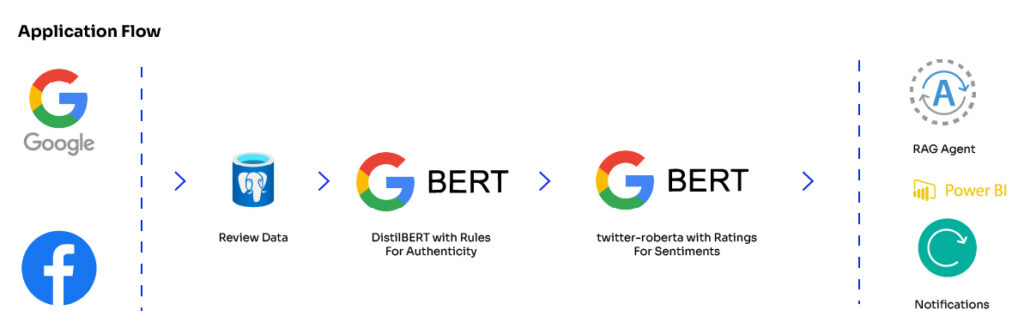
Step 2: Collect customer feedback automatically
The platform continuously gathers public feedback from sources like Facebook (posts, comments, and reviews) and Google reviews, ensuring a steady stream of real-time insights.
Step 3: Clean and prepare the data
The system removes noise, filters duplicates, and standardizes text to ensure consistent, accurate, and authentic sentiment analysis.
Step 4: Analyze sentiment using AI
Each piece of feedback is classified as positive, neutral, or negative, with a sentiment score and confidence level assigned to improve reliability.
Step 5: Categorize feedback by business area
Feedback is grouped into key categories such as customer support, pricing, delivery, and product quality, along with others relevant to your business, helping you pinpoint where issues or strengths lie.
Step 6: Identify patterns and emerging issues
Using advanced clustering, the system detects recurring themes and flags unusual spikes in negative sentiment, whether across the business or within specific areas.
Step 7: Visualize insights through dashboards
Insights are presented through intuitive dashboards that highlight sentiment trends, top issues, and key strengths, with filters for platform, location, time period, and any other areas relevant to your business.
Step 8: Drill down and take action
Teams can explore individual feedback entries, perform keyword searches, and export data for deeper analysis enabling faster, more informed decision-making.
Real-world impact: Reclaiming the customer narrative
A leading automotive distributor faced the challenge of managing high volumes of customer feedback across multiple touchpoints while distinguishing meaningful insights from the noise.
With the AI Sentiment & Conversational Insights Agent, the team moved beyond manual monitoring to automated, high-precision brand management. The agent verified feedback authenticity, categorized sentiment across key business areas, and identified emerging patterns in real time.
This enabled the organization to uncover specific regional trends and gain clearer visibility into customer experiences across the business. The agent also detected nuanced signals such as inconsistencies between ratings and feedback, ensuring no critical insights were overlooked.
By transforming unstructured feedback into actionable intelligence, the organization was able to respond faster, improve customer engagement, and strengthen overall brand trust.
The future is multi-agent
As we look toward 2026, forward-thinking enterprises are aiming for intelligence at scale. The introduction of the sentiment and conversational insights agent marks another step in Fortude’s evolution, from standalone AI tools to a coordinated multi-agent ecosystem.
By offloading repetitive, data-intensive analysis to specialized agents, organizations are not just automating tasks; they are enabling people. Brand managers and leadership teams are freed to focus on strategic thinking and relationship-building, the areas where human insight matters most.
Whether it is forecasting the next trend or protecting your brand’s reputation in real time, agentic AI ensures your operations are intelligent, resilient, and future-ready.
Talk to us to learn how this agent can support your business.
Ready to explore what Agentic AI could look like in your enterprise?
Let Fortude guide your transformation with experience, insight, and purpose.
FAQs
A Multi-Agent System is a coordinated network of specialized autonomous agents working together toward a shared objective. Unlike single agents, MAS allows different agents with unique roles and datasets to collaborate, negotiate, and solve complex problems collectively, providing high-level performance across messy and multidimensional enterprise environments.
MAS offers significant advantages over single agents, including scalability to add new agents without redesigning the system and increased resilience by distributing workloads. These systems are highly adaptable, dynamically changing as conditions evolve, and provide greater accuracy for complex, end-to-end automation across interconnected enterprise workflows.
Fortude’s Signal-Based Forecasting Agent integrates internal sales data with external market signals like weather and emerging trends to suggest precise purchase order quantities. Meanwhile, the Inventory Levelling Agent assesses network-wide risks and proactively recommends stock transfers between stores to prevent imbalances and stockouts.
Agents coordinate through orchestration models: centralized (lead agent control), decentralized (direct negotiation), or hybrid, which balances control with flexibility. These structures can mirror real organizational behaviors, such as hierarchical or team-based patterns, ensuring agents handle complex tasks while maintaining alignment with enterprise goals and human oversight.
Subscribe to our blog to know all the things we do